Chandragupta Maurya: History, Jain Tradition and a Comparative Study of the Available Sources
From the power of Magadha to Shravanabelagola — a careful study that reads political history and Digambar Jain memory each on its own evidence, with four figures and source references.
Summary · AI
- A research essay on Chandragupta Maurya that keeps political history and the Jain tradition distinct from each other.
- Greek and Roman accounts, the surviving fragments of Megasthenes, the Arthashastra, Jain literature and the Shravanabelagola inscriptions — the limits of each group of sources are set out as well.
- The Digambar Jain tradition connects him with Acharya Bhadrabahu and remembers the journey south and sallekhana; the essay holds this with respect, as tradition.
- At the end the evidence is placed in three categories: what is relatively certain, what is preserved as tradition, and what is still disputed.
This summary was written by AI and may contain mistakes; the article itself is authoritative.
This is an English translation of the original Hindi. Translation may have changed the meaning a little; the Hindi original is the authoritative version.
Editorial note: This revised research edition keeps the full subject matter of the original article and its respect for the Jain tradition, while making the language of its historical claims more careful. Where the facts are relatively well attested, they are stated as facts; where an account rests on literary tradition, later inscriptions or modern interpretation, that distinction is made clear.
Introduction: the historical importance of the Mauryan empire
Chandragupta Maurya is among those rulers of ancient Indian history whose rise brought a large change in the political structure of northern India. In the second half of the fourth century BCE, building on the power of Magadha, he founded an empire whose influence reached across the north-western part of the Indian subcontinent. What we know of his reign comes from limited sources of several different kinds. In studying Chandragupta it is therefore necessary to keep political history, classical Greek and Roman accounts, Indian literary traditions, archaeological evidence and the Jain tradition distinct from one another.
Chandragupta’s importance does not lie in military campaigns alone. In his time the Magadha-based state expanded, administrative institutions developed, and diplomatic relations were established with the Seleucid power in western Asia. On the other side, the Digambar Jain tradition remembers him as a man who gave up royal power and took up the life of an ascetic. This tradition holds a special place in Jain historical memory; at the same time, modern historical scholarship continues to discuss the dating and the historical identification of some of its details. The aim of this article is to present both sides — political history and Jain memory — respectfully and in keeping with the evidence.
1. The sources and their limits
There is no contemporary, complete and sequential biography of Chandragupta Maurya that records the events of his life from birth to his last days beyond dispute. Historians have to compare scattered references in a variety of sources. The main groups of sources include the accounts of Greek and Roman writers, the surviving fragments associated with Megasthenes, Indian drama and the Puranic traditions, Buddhist texts, and Jain literature and inscriptions. Each of these differs in date of composition, purpose and distance from the events.
The material associated with Megasthenes is of particular importance, because he was a Greek ambassador connected with the Mauryan court. But his original work, the Indica, has not survived in full. Its fragments are known through the quotations and summaries of later writers. Before describing any statement as a word-for-word quotation from Megasthenes, therefore, its original context and text must be checked. Where confirmation of the original quotation is not available, careful language such as “later accounts associated with Megasthenes suggest” is more appropriate in an article.
For the Jain tradition, the Parishishtaparvan and other Jain literary works are important. These texts preserve the memory of Chandragupta, Acharya Bhadrabahu, and the movement of a part of the Jain sangh towards southern India. But the date of a literary composition and the date of the event it describes cannot be taken as the same. In the same way, an inscription engraved later at a site may be evidence of an older tradition, yet it is not necessarily contemporary proof of the event. In writing history, respecting a source goes together with recognising its limits.
2. Birth, lineage and early life
The sources do not agree about Chandragupta’s birthplace, family and social background. Different Indian literary traditions present his lineage and early life in different ways. The Greek writer Justin describes him as coming from a low social background, while Indian traditions give varying accounts of his descent. It would not be proper to present these descriptions as a single settled genealogy.
A literary drama such as the Mudrarakshasa contains a political narrative about Chandragupta and Chanakya, but a play should not be read as a contemporary state record. Its literary purpose, dramatic structure and date of composition all affect how it can be used as history. Similarly, the stories of his childhood preserved in Jain and Buddhist texts are useful for understanding how Chandragupta was remembered and how ideal leadership was imagined, but they cannot be treated as direct historical fact in every detail.
In writing Chandragupta’s early life, then, the most appropriate conclusion is that the fine detail of his birth and lineage is uncertain. His historical role — the change of power in Magadha and the founding of the Mauryan empire — does not depend on any one disputed account of his descent.
3. The end of Nanda rule and the rise of Chandragupta
Chandragupta’s rise was connected with the last phase of Nanda rule in Magadha and with the political conditions that arose in the north-west after Alexander’s campaign. The wealth and large military strength of the Nanda rulers are mentioned in the tradition of ancient writers. Some literary sources portray the Nandas as unpopular or harsh rulers. Even so, to say that the whole population was in revolt against Nanda rule at once, or was waiting for Chandragupta, would be a claim wider than the available evidence.
After Alexander’s death in 323 BCE, conflict grew among his generals and successors over the different regions of his empire. As power relations shifted in the north-west, new opportunities opened for local powers. Chandragupta took advantage of this situation and gradually increased his strength. The exact sequence of his campaigns and the details of each battle are not clearly preserved; care is therefore needed in constructing an over-detailed, confident timeline of events.
The role of Chanakya, or Kautilya, is extremely important in Chandragupta’s story. Indian tradition presents him as a political adviser and an opponent of Nanda power. Studying the different forms of the Chanakya–Chandragupta story, historians observe how historical memory, political thought and literary imagination are mixed in them. Scholars have discussed the historicity of Chanakya and the tradition surrounding him, but every dialogue or episode of the story cannot be taken as an attested event.
The replacement of Nanda power by Mauryan power made Magadha the centre of an extensive empire. To call this change “the birth of the nation state” in the modern sense can create anachronism. It can be said more precisely that Chandragupta played a decisive role in organising a large part of northern India under a centralised empire.
4. Chanakya and the Arthashastra: thought and history
The Arthashastra, associated with the name of Kautilya, is an important text on the ancient Indian system of the state, revenue, penal policy, diplomacy, the intelligence service, agriculture, trade and administration. It contains a detailed treatment of the state’s many departments, officials, taxes, punishments and royal duties. Studying this text can help in understanding the possible institutional background of Mauryan governance.
Even so, the conclusion that “Chandragupta implemented every arrangement described in the Arthashastra in exactly that form” does not follow by itself. The date of the text, the process of its composition and its authorship have all been debated by scholars. Thomas R. Trautmann’s studies raised questions about the structure of the text and its possible composition in layers. To treat the Arthashastra as a single-author work written at one time, and to call everything in it a direct description of Chandragupta’s rule, would therefore run against that caution.
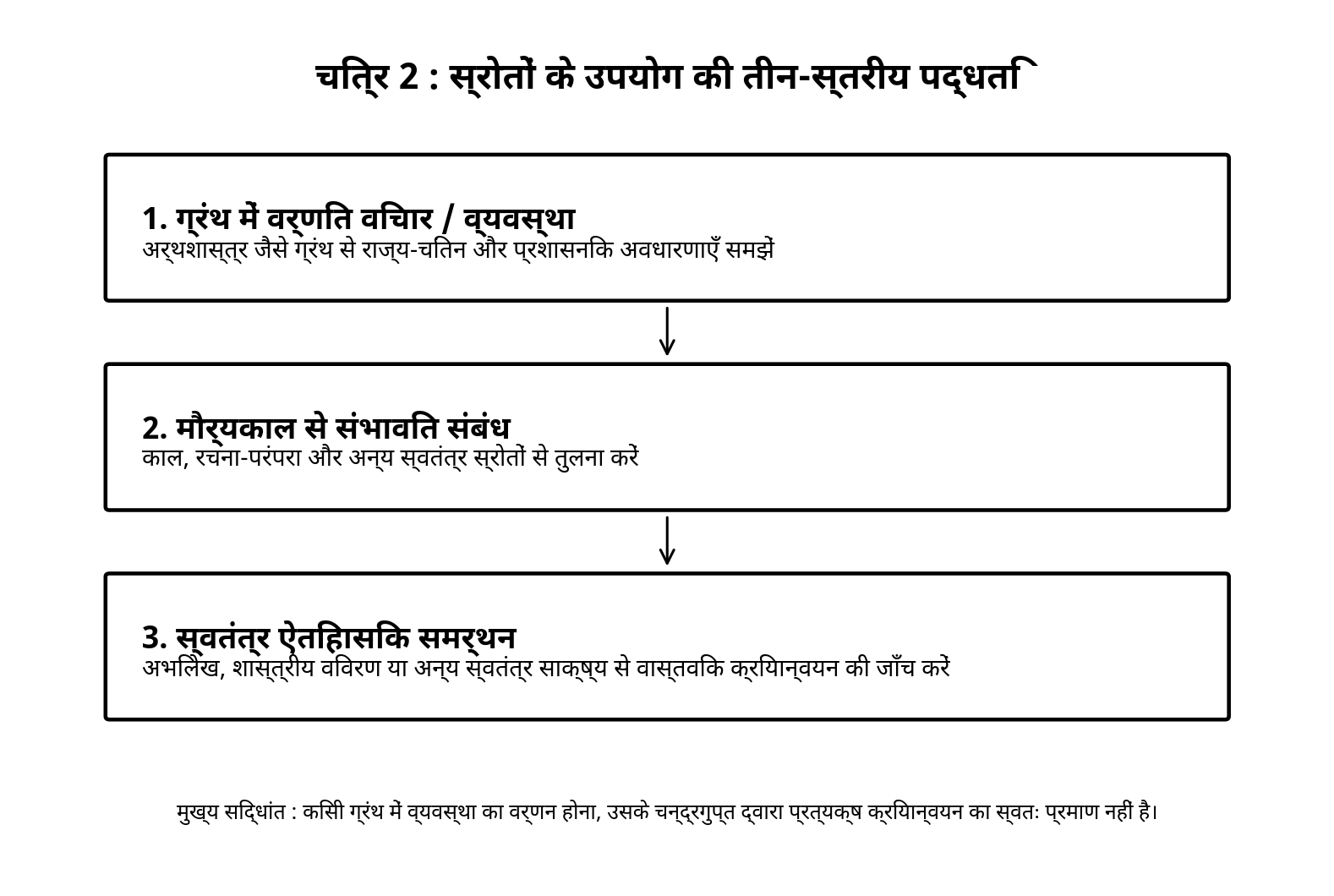
In this article it is appropriate to use the Arthashastra at three levels: first, the principles of governance described in the text; second, the possible relationship of those principles to Mauryan administration; and third, independent evidence that supports the actual working of any particular arrangement. A conclusion at the third level should not be drawn from the first level alone. For example, the presence in the text of descriptions of revenue or of officials indicates that such administrative ideas had developed in that period or in the text’s tradition of composition; but additional evidence is needed before concluding that a particular department worked in exactly that form under Chandragupta’s rule.
None of this lessens the importance of the Arthashastra. It is evidence of a rich tradition of ancient Indian political thinking about the state and about power. In connecting it with Chandragupta’s history, keeping a clear distinction between proof and probability is the more reliable method.
5. Administration, economy and everyday life
Revenue collection, the organisation of officials, communication, military arrangements and control over local resources must all have been important to the expansion of the Mauryan empire. Ancient states generally depended on agricultural production, trade, craft, minerals and taxes of various kinds. The Arthashastra sets out detailed theory on these subjects, and the accounts associated with Megasthenes give a glimpse of some aspects of Mauryan society and governance. On the basis of these sources the complexity of Mauryan administration can be discussed, but it is not proper to assume that the arrangements were the same in every province, or that every policy remained in force continuously.
Agriculture was the main foundation of the ancient economy. Arrangements concerning irrigation, land, crops, taxes and rural production were necessary to the stability of any large state. Trade routes, towns and craft production also contributed to the empire’s economic activity. But broad conclusions in an article, such as “the tax system was fairer than that of the Nandas”, “farmers were protected in every situation” or “the people were prosperous and content”, should be written only when clear sources are available for them. There can be a difference between royal ideals and the actual experience of ordinary people.
The tradition associated with Megasthenes contains descriptions of city administration, of various groups in society, and of the organisation of officials. These descriptions should be read as fragments preserved by later writers. If a statement is given in quotation marks, the reference to its original source, chapter or section is necessary. Otherwise it should be presented as a careful summary rather than as a direct quotation.
In drawing conclusions about the position of women, the rights of workers, slavery, social mobility and welfare arrangements, these subjects too should be considered separately. General statements such as “the position of women was good” or “there was wide equality in society” can conceal the variety of social life. It is better to note the separate indications in the available sources concerning marriage, property, labour, religious participation and royal service, and to keep conclusions limited where the evidence is insufficient.
Ashoka’s inscriptions contain clear references to public welfare and to medical provision for human beings and animals. Such policies should not be attributed to Chandragupta’s rule without independent evidence. Understanding the long tradition of the Mauryan dynasty is useful, but merging the reigns of Chandragupta, Bindusara and Ashoka into a single administrative moment erases historical difference.
6. The army and the expansion of the empire
The army played an important part in the expansion and stability of Mauryan power. Ancient sources give large figures for the size of the Mauryan army. The account associated with Plutarch mentions 600,000 infantry; other classical traditions also give numbers of cavalry and elephants. But ancient military figures can sometimes be estimates, exaggerations, or shaped by a later textual tradition. Figures such as 600,000 infantry, 30,000 cavalry and 9,000 elephants should therefore be presented not as an undisputed census but as claims preserved in classical sources.
The importance of the army did not lie in war alone. A large empire needed military resources to protect its frontiers, to secure highways and trading areas, to suppress revolts and to establish royal authority. Even so, when making a claim about a particular military organisation, system of recruitment or supply arrangement, the source must be named. The Arthashastra describes ideal military management, but independent confirmation is needed before treating it as a direct report of Chandragupta’s rule.
Care is also necessary about the geographical extent of the Mauryan empire. The centre of Chandragupta’s power was Magadha, and its influence extended over northern India and the north-west. Separate evidence is needed to claim his direct administrative control over every region of southern India. The empire’s political influence, military campaigns, submission of other rulers, trading contacts and direct administration are related but distinct concepts.
7. Conflict and treaty with the Seleucid power
After Alexander’s death, Seleucus I Nicator established his power in western Asia among his successors. Around 305 BCE his campaign towards the Indian subcontinent met the rising power of Chandragupta Maurya. The available classical sources give no detailed account of the fighting in this conflict, but its outcome took the form of an agreement.
According to the Encyclopaedia Iranica, this agreement involved the passing of certain regions around the Hindu Kush and to its south-east — among them names such as Paropamisadae, Aria, Arachosia and Gedrosia — from Seleucid control to Mauryan power. In return, Seleucus received 500 war elephants. Some details of this agreement are unclear in the ancient sources; it is therefore difficult to state the exact line of the frontiers or all the terms of the treaty with full certainty.
A marital or dynastic alliance is also mentioned in scholarly discussion. But the available sources do not give the full details of such a connection. Rather than a definite sentence such as “Seleucus married his daughter to Chandragupta”, it is more appropriate to write that the treaty is mentioned along with the possibility of some kind of marital or dynastic relationship, whose nature is not clear.
The mention of the 500 elephants is among the most discussed parts of this agreement. Seleucus later used elephants in the wars of western Asia. The episode makes clear that Mauryan power was not confined to politics within the subcontinent, but was also significant in military and diplomatic relations with the powers of western Asia. Even so, rather than calling it a “global power” in the modern sense, it would be more accurate historically to call it one of the major regional imperial powers of its time.
8. Megasthenes and the Mauryan court
Megasthenes is generally held to have been an ambassador sent to the Mauryan court on behalf of the Seleucid ruler. His account matters because it gives information about some aspects of the Mauryan state and Indian society from the viewpoint of an outside observer. But his Indica is not available in full. Later Greek and Roman writers used fragments of it, and it is through them that we reach Megasthenes’s observations.
For this reason, statements in an article such as “Megasthenes writes that crime was very rare”, “farmers were always protected” or “the people were entirely content” should be kept as word-for-word quotations only when their attested text and context can be given. If such a reference is not available, a better sentence would be: “Later accounts associated with Megasthenes indicate certain organised aspects of the administration and social life of the Mauryan state.” This language acknowledges the importance of the source without claiming more than the available evidence.
The accounts of the Greek writers should be read alongside Indian literary sources and inscriptional evidence. An outside writer’s view can be affected by his own cultural assumptions and sources of information; in the same way, Indian literary traditions can have their own religious, moral or political purposes. A more balanced historical picture emerges only from comparing many sources.
9. Chandragupta and the Jain tradition
Chandragupta Maurya holds a distinctive place in the Digambar Jain tradition. According to this tradition, in the later part of his life he came into contact with Acharya Bhadrabahu, accepted the Jain dharma, gave up royal power, and established a connection with the Jain sangh that went towards southern India. This account presents Chandragupta not merely as a conquering emperor but as a seeker moving towards detachment, austerity, restraint and self-discipline. In Jain history and community memory this account carries deep religious and cultural significance.
Jain texts remember Bhadrabahu as an acharya of great distinction. According to the tradition, because of the prospect of famine or of difficult conditions in northern India, a part of the Jain sangh went towards the south. The account of Chandragupta’s participation in this migration is found in later Jain literary and inscriptional traditions. Different texts can differ in their description of events and in their dating; all these accounts should therefore not be presented as a single settled historical narrative.
The Jain tradition of Shravanabelagola connects Chandragupta and Bhadrabahu in a particular way. The later inscriptions and monuments there are important for the history of this tradition. But the available inscriptional evidence is not contemporary with Chandragupta’s lifetime; it is more careful to read it as evidence of a memory and a tradition several centuries later. For this reason, to say that the inscriptions prove his initiation and his journey south directly and conclusively would be a claim more confident than necessary.
This caution does not mean rejecting the Jain tradition. The work of historical method is to say which account is supported by contemporary evidence, which is preserved in a later religious and literary tradition, and at which point scholars differ. The study of the Jain memory of Chandragupta is extremely valuable in this respect, because it offers an opportunity to reflect on the relations between royal power, dharma, austerity and renunciation in ancient India.
10. Shravanabelagola, Bhadrabahu and sallekhana
Shravanabelagola is a major Jain tirth in Karnataka, whose hills, basadis and inscriptions hold a special place in Jain history. The tradition concerning Bhadrabahu and Chandragupta made this site an important centre of religious memory. The hill and the monumental traditions associated with Chandragupta are, for the Jain community, not only historical indications but also an expression of the ideal of renunciation and spiritual practice.
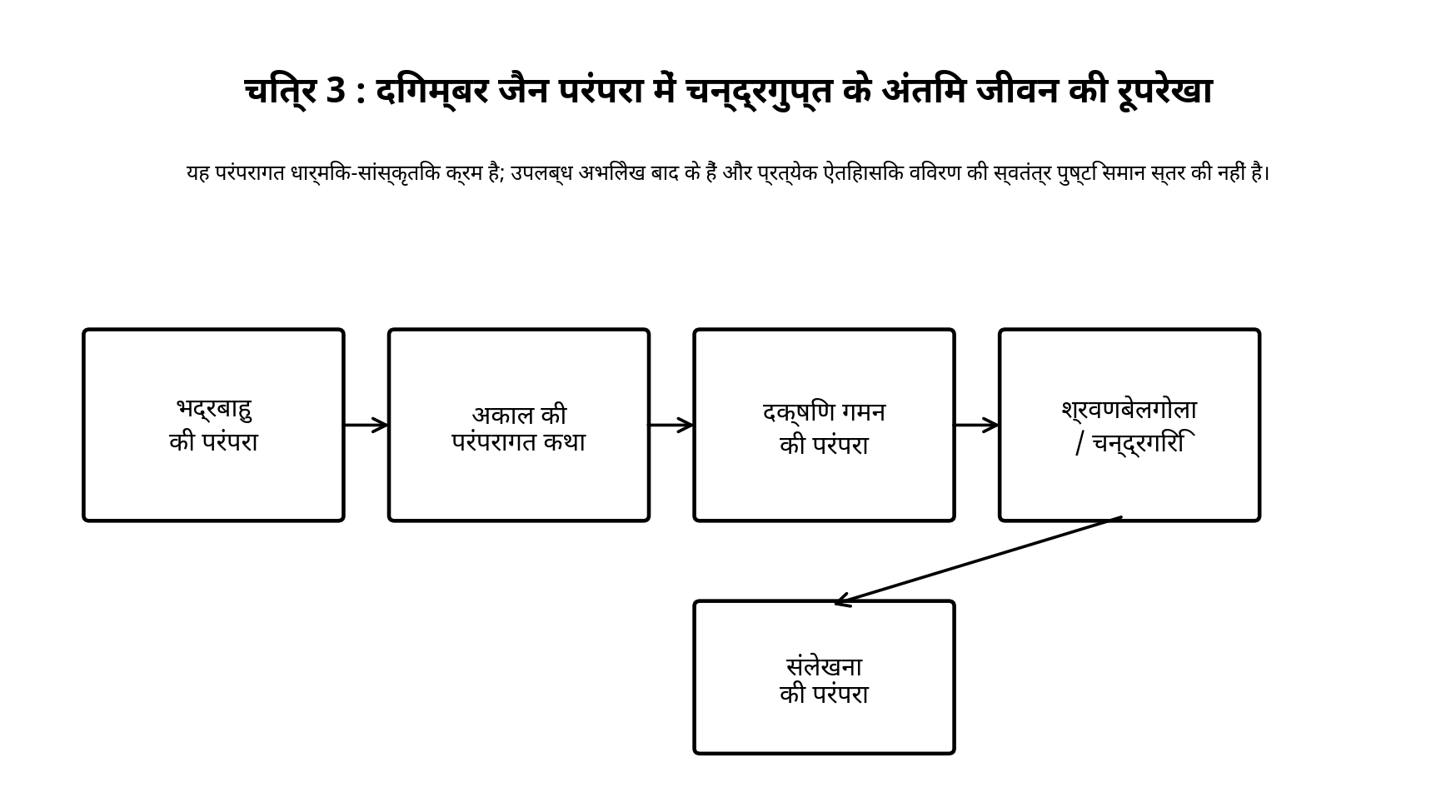
According to the Jain tradition, Chandragupta took the vow of sallekhana in the last phase of his life. In Jain conduct, sallekhana is held to be a religious vow undertaken in the last phase of life in a spirit of equanimity, restraint and the wearing away of attachment. In writing on this subject, the Jain tradition’s own religious interpretation should be presented clearly, and it should also be stated that the historical account of Chandragupta’s adoption of it is known through tradition, and not from any contemporary detailed biography.
A balanced sentence for this article would therefore be: “The Jain literary and inscriptional tradition of Shravanabelagola connects Chandragupta Maurya with Bhadrabahu and relates his last years to austerity and sallekhana. The available inscriptions are later; scholars therefore differ over the historicity of this identification, while in the Digambar Jain tradition the account is preserved as something of great importance.” Put this way, both respect for the religious tradition and source criticism are kept together.
11. Chandragupta’s legacy and historical assessment
Chandragupta Maurya’s legacy can be understood at several levels. At the political level he made Magadha the centre of an extensive empire and established effective relations with the powers of the north-west. At the administrative level, Mauryan rule offers an example of organising the resources, officials and military strength of a large territory. At the cultural level, different traditions built up memories of him — Greek and Roman writers remembered him in terms of political and military power, while the Jain tradition gave particular importance to his renunciation and spiritual practice.
To claim that the later Gupta, Chalukya, Rashtrakuta, Chola, Pala and Sena rulers directly adopted Chandragupta’s own administrative system is a very broad conclusion. There can be similarities in the administration of different dynasties, but similarity does not by itself prove direct institutional succession. Such a claim requires a comparative examination of particular departments, inscriptions, revenue systems and historical contacts. The safer conclusion is that the Mauryan empire offered an important historical example of the organisation of a large empire in the Indian subcontinent.
In the same way, to call Chandragupta’s Jain tradition the direct cause of Ashoka’s Buddhist policy would go beyond the evidence. The relation between dharma and royal power in the lives of both Chandragupta and Ashoka can be discussed, but sufficient independent evidence is not available to establish the causal connection that Chandragupta’s reported Jain initiation directly determined Ashoka’s religious direction. It should be presented as comparative reflection or possible interpretation rather than as established fact.
In assessing Chandragupta, modern terms — “nation builder”, “global power”, “welfare state” or “modern administration” — should be used with care. These words can give the reader a ready understanding, but if they are applied to ancient times without explanation they can impose modern concepts on the past. More accurate language would be that Chandragupta established a centralised empire over a large part of northern India and gained a decisive place in ancient Indian political history.
12. What is relatively certain, and what is tradition?
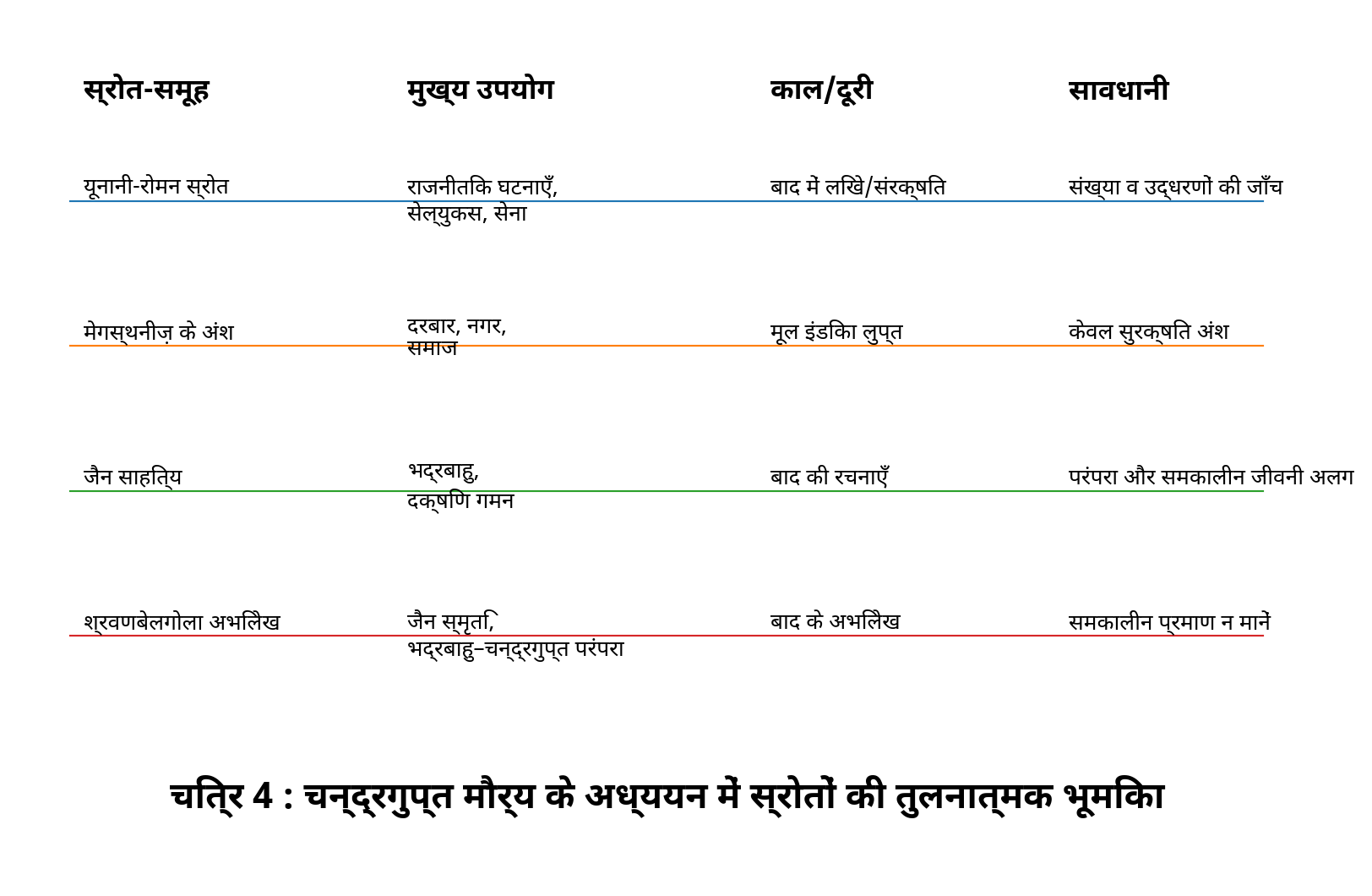
To understand Chandragupta’s history it is useful to place the evidence in three categories. The first category holds those matters that find sufficient support from several sources: that Chandragupta was a historical Mauryan ruler; that he established a Magadha-centred empire after Nanda power; that he had a conflict and then an agreement with Seleucus I; and that classical sources mention Seleucus receiving 500 war elephants. Megasthenes’s connection with the Mauryan court is also an important part of the ancient tradition of sources.
The second category holds those accounts that are deeply preserved in the Jain tradition, but for which independent confirmation of every historical detail is limited: Chandragupta’s connection with Bhadrabahu, the journey towards southern India, his stay at Shravanabelagola, and the leaving of the body through sallekhana. Their Jain religious and cultural importance is clear; in historical analysis they should be recognised as tradition, and the dating of the later inscriptions should be kept in mind.
The third category holds those claims about which the evidence is insufficient or disputed: Chandragupta’s exact birthplace and lineage; the precise account of his meeting with Chanakya; the extent of popular discontent with Nanda rule; the exactly accurate numbers of the Mauryan army; the particular nature of the marital agreement with Seleucus; and the direct influence of Chandragupta’s religious journey on Ashoka’s policies. Such subjects should be presented as questions, possibilities or tradition rather than as settled conclusions.
Conclusion
The life of Chandragupta Maurya offers an opportunity to understand both the political change and the religious memory of ancient Indian history. The available sources present him as a ruler who transformed the power of Magadha into an extensive empire and made an important diplomatic agreement with the Seleucid power of western Asia. In studying Mauryan administration, the army and the economy, the classical accounts and the Arthashastra are useful, provided their period, their nature and their limits are kept in mind.
The Digambar Jain tradition remembers Chandragupta as a seeker who gave up royal splendour and moved towards restraint and austerity. This tradition, connected with Bhadrabahu, the journey south and Shravanabelagola, is an important inheritance of Jain history. From the point of view of modern research, discussion continues over the confirmation and dating of some of its details; this does not end its cultural and religious importance. Rather, careful comparative study of tradition, inscription and literature makes history richer.
A balanced biography of Chandragupta Maurya should therefore neither go beyond the sources and declare every account an undisputed fact, nor ignore the Jain tradition because of historical uncertainty. Classification of the evidence, referenced quotation, care with dates and less repetition — these can make this article a more reliable, readable and research-worthy study.
- Ancient sources: Plutarch, Life of Alexander, chapter 62; Strabo, Geography, 15.2.9 and related passages; Appian, Syriaca, 55; Justin, Epitome of Pompeius Trogus, 15.4. Quote these sources only after checking the reference numbers in the translations and editions used.
- Jain literature: Hemachandra, Parishishtaparvan; Jain literary traditions concerning Bhadrabahu and Chandragupta; published collections of the Shravanabelagola inscriptions. When using a particular edition or translation, add the editor, publisher, year and page number.
- Thomas R. Trautmann, The Structure and Composition of the Kautiliya Arthasastra, SOAS, 1968. DOI: https://doi.org/10.25501/SOAS.00029462
- Thomas R. Trautmann, Kautilya and the Arthasastra: A Statistical Investigation of the Authorship and Evolution of the Text, Brill, 1971.
- Pierfrancesco Callieri, “India iv. Relations: Seleucid, Parthian, Sasanian Periods,” Encyclopaedia Iranica. https://iranicaonline.org/articles/india-iv-relations/
- R. P. Kangle, The Kautiliya Arthasastra, 3 volumes, University of Bombay. A useful standard reference for the original text, translation and study.
- Upinder Singh, A History of Ancient and Early Medieval India: From the Stone Age to the 12th Century, Pearson, 2008.
- Romila Thapar, Aśoka and the Decline of the Mauryas, Oxford University Press. For the wider context of Mauryan history and the problem of sources.
13. The method of writing history: fact, tradition and interpretation
The most useful way to read the material available on Chandragupta Maurya is to ask of every statement: what is its source, how old is that source, is it direct or preserved through a later tradition, and is it supported by any other independent source? By this method history and tradition do not become opposed to each other; rather, the role of each becomes clear.
For example, the agreement between Chandragupta and Seleucus is supported by ancient classical sources. The mention of 500 elephants is found clearly in Plutarch, while modern scholars have also considered the roundness of that figure. [1] In the same way, the connection between Chandragupta and Bhadrabahu is of great importance in the Jain tradition, but its historical details should be read in the context of later literature and the inscriptional tradition.
The same caution is necessary in the case of the Arthashastra. The text contains many institutions and ideas that match Mauryan governance, but scholars differ over the process of its composition and compilation. Trautmann’s studies have raised questions about the assumption of a single author. It is therefore proper to use the text as an important source for the study of Mauryan political thought, but it would not be proper to treat each of its provisions as Chandragupta’s direct policy.
One further benefit of this method is that proving Chandragupta’s greatness no longer requires exaggeration. His historical importance is sufficient in itself — the expansion of the power of Magadha, the organisation of a large empire, the agreement with the Seleucid power, and the founding of a political tradition that prepared the ground for later Mauryan rule. On the other side, his renunciation and ascetic form in the Jain tradition are a separate and important legacy from the point of view of Indian religious history.
14. Overall conclusion: from emperor to seeker
To treat the life of Chandragupta Maurya only as a story of conquest and empire would be incomplete, and to treat it only as a Jain account of renunciation would diminish his political history. Comparative study of the available evidence allows us to see him first as a rising political leader, then as the ruler of a powerful empire, and finally, in the Jain tradition, as a seeker who had renounced.
The most important fact about his political life is that he developed the Magadha-centred Mauryan state into an extensive empire after Nanda power. In the shifting structure of power among Alexander’s successors he took advantage of the situation in the north-west, and after the agreement with Seleucus he strengthened the western frontier of Mauryan power. Classical sources mention the exchange of 500 war elephants and Chandragupta’s large military strength; these numbers should be read as claims in historical sources, and not like a modern census. [1]
On administration and the economy, the Arthashastra and the material associated with Megasthenes are useful, but it is not proper to build on them an image of a “modern” or “wholly welfare” state. Ancient governance had its own structure, its limits and its severe penal system. It is more meaningful to understand the achievement of the Mauryan state within its own historical context.
From the Jain point of view, the last part of Chandragupta’s life holds particular importance. The tradition associated with Bhadrabahu, the journey south, Shravanabelagola and sallekhana is preserved in Digambar Jain history with deep reverence and memory. For the historian, the proper approach here is neither to declare this tradition a contemporary fact without question, nor to treat it as meaningless because of the later date of the inscriptions. It is more just to present it as an important historical and cultural tradition.
In this way the most lasting picture of Chandragupta Maurya is made of two complementary dimensions — royal power and renunciation. On one side he appears among the most important empire-builders of ancient India; on the other, the Jain tradition remembers him as a seeker who went from the summit of power to the path of restraint and austerity. It is this duality that makes his personality distinctive in both Indian history and the Jain tradition.
- Plutarch, Life of Alexander, 62 — for the mention of Chandragupta (Androcottus), 500 elephants and an army of 600,000.
- Strabo, Geography, 15.2.9 and related passages — for the Seleucus–Chandragupta agreement and the diplomatic relationship.
- Appian, Syriaca, 55; Justin, Epitome of Pompeius Trogus, 15.4 — for Seleucus and his relations with the Mauryas.
- Thomas R. Trautmann, The Structure and Composition of the Kautiliya Arthasastra — for the debate on the composition and authorship of the Arthashastra.
- R. P. Kangle, The Kautiliya Arthasastra — for the original Sanskrit text, translation and study.
- For the Jain tradition, use attested edited versions of the Parishishtaparvan and of the Shravanabelagola inscriptions.
- Give the original source and the section or chapter number with every direct quotation. If the original text cannot be confirmed, remove the quotation marks and use summary language.
- For transparency in research it is necessary to give “according to the Jain tradition” with claims drawn from that tradition, and the approximate date of later inscriptions.
List of figures
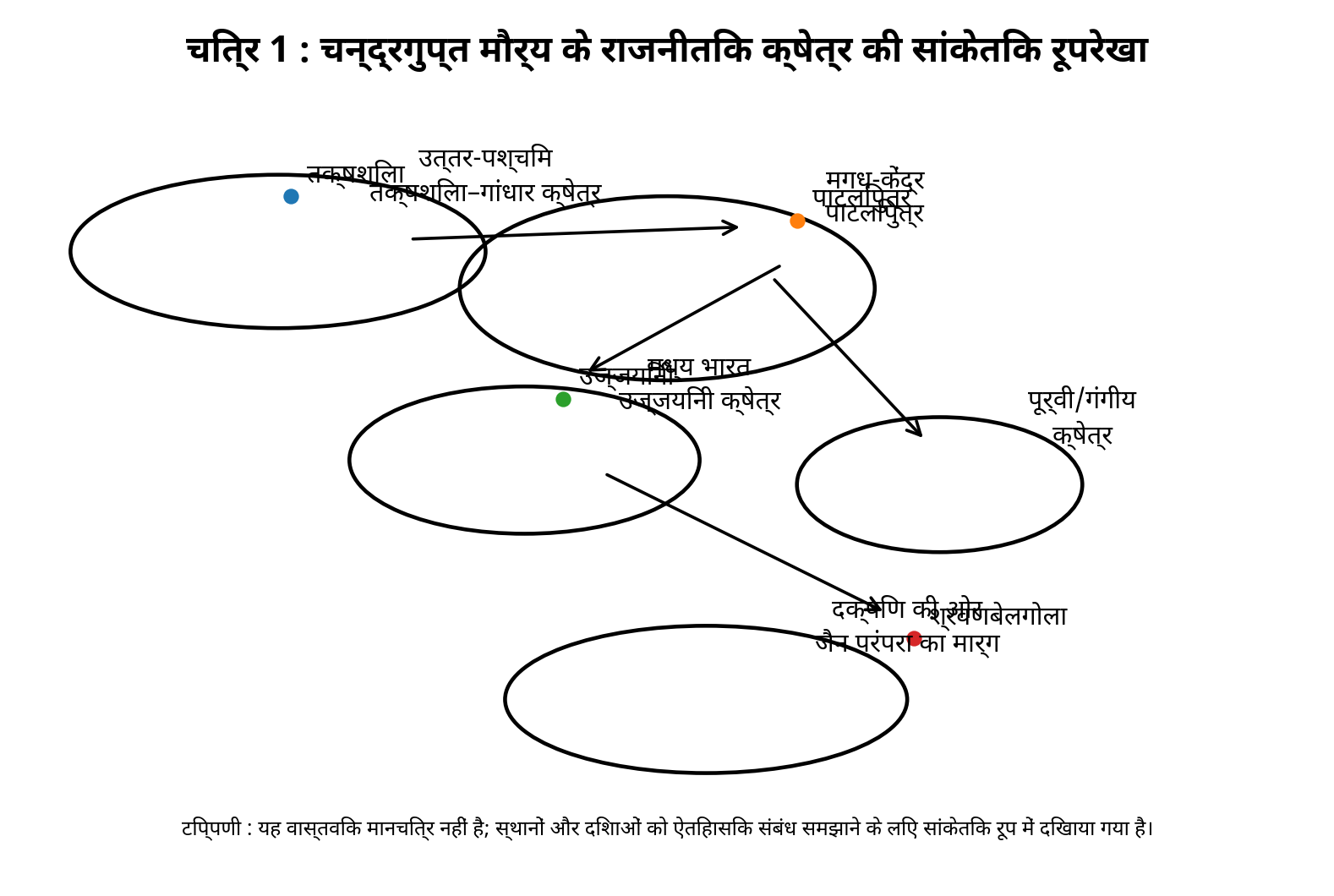
- Figure 1 — A schematic outline of Chandragupta Maurya’s political sphere.
- Figure 2 — The three-level research method for using a text such as the Arthashastra.
- Figure 3 — The traditional outline of Chandragupta’s last years in the Digambar Jain tradition.
- Figure 4 — The role and the limits of the different groups of sources in the study of Chandragupta Maurya.
Notes and source references
- Plutarch, Life of Alexander, 62 mentions 500 elephants and 600,000 soldiers in connection with Androcottus. The figures are taken here as details recorded in an ancient source, not as modern verified military statistics.
- On the Seleucus–Chandragupta agreement, Strabo, Geography 15.2.9, Appian, Syriaca 55 and Justin, Epitome of Pompeius Trogus 15.4 are useful classical sources. For a modern review, see the Encyclopaedia Iranica articles “India iv. Relations” and “Seleucus”.
- Megasthenes’s Indica has not survived in full. The available material comes from fragments preserved by later writers. It is therefore not proper to give word-for-word quotations without checking the original reference.
- Scholars differ on the date, process of composition and authorship of the Arthashastra. Thomas R. Trautmann’s SOAS study of 1968 raised questions about its possible multi-author structure; his Brill study of 1971 made a statistical examination of authorship and the development of the text.
- The Digambar Jain tradition connects Chandragupta with Acharya Bhadrabahu and presents the account of the journey south and of sallekhana. The tradition and the monuments of Shravanabelagola give this connection a special place in Jain historical memory.
- The available inscriptions concerning Shravanabelagola are not contemporary with Chandragupta’s time. In the published material, inscriptions connected with the Bhadrabahu–Chandragupta tradition are found from about the sixth century CE onwards. They are therefore treated in this article as later inscriptional evidence of a tradition.
- There has been disagreement between tradition and modern scholars over the identification of “Prabhachandra” with Chandragupta Maurya. Where this identification is not definitely established, the article has used careful language.
- The Mudrarakshasa is a useful literary source in the study of historical memory, but it cannot be taken as a direct state record of Chandragupta’s time.
- The fine details of Chandragupta’s birthplace, lineage and early life differ between traditions; the article has therefore not presented any one disputed genealogy as settled fact.
- Modern terms such as “nation state”, “global power” or “welfare state” can create historical anachronism. In their place the article has preferred a more limited and accurate description of the political structure of that time.
- Ashoka’s inscriptions contain clear references to welfare and medical policies; these have not been attributed to Chandragupta’s rule without independent evidence.
- In the Jain tradition, sallekhana is understood as a religious vow of the last phase of life, connected with equanimity, restraint and the wearing away of attachment. It is presented here according to the Jain religious view; the historical account of Chandragupta’s observance of it rests on tradition.
- Figure 1 and figures 2–4 are schematic and educational illustrations prepared for this edition. Figure 1 should not be taken as an actual historical boundary map.
- If direct quotations from a particular edition are added for publication, the book, chapter or verse — or the inscription number — and the page number should be checked a final time.
Selected bibliography
- Plutarch. Life of Alexander. Chapter 62.
- Strabo. Geography. Book 15, especially 15.2.9 and related passages.
- Appian. Syriaca. Chapter 55.
- Justin. Epitome of Pompeius Trogus. Book 15.4.
- Hemachandra. Parishishtaparvan.
- Rice, B. Lewis. Epigraphia Carnatica, Vol. II: Inscriptions at Sravana Belgola.
- Trautmann, Thomas R. The Structure and Composition of the Kautiliya Arthasastra. SOAS, 1968.
- Trautmann, Thomas R. Kautilya and the Arthasastra: A Statistical Investigation of the Authorship and Evolution of the Text. Brill, 1971.
- Kangle, R. P. The Kautiliya Arthasastra. 3 vols., University of Bombay.
- Callieri, Pierfrancesco. “India iv. Relations: Seleucid, Parthian, Sasanian Periods.” Encyclopaedia Iranica.
- “Seleucus.” Encyclopaedia Iranica.
- Singh, Upinder. A History of Ancient and Early Medieval India. Pearson, 2008.
- Thapar, Romila. Aśoka and the Decline of the Mauryas. Oxford University Press.
Figure sources and credits
- Free-source examples usable for actual site photographs: “Footprint of Chandragupta Maurya” on Wikimedia Commons — KGBedits, CC BY-SA 4.0.
- “Chandragupta Basadi (Inscription), Shravanabelagola 04” on Wikimedia Commons — Rohit14400, CC BY-SA 4.0.
- “Shravanabelagola - Gommateshwara” on Wikimedia Commons — Venkygrams, CC BY-SA 4.0.
- In this edition, four self-prepared schematic figures have been used instead of external photographs, so that the position on figure credits and reprinting stays clear in the manuscript.
Comments